
The Clay & Glaze Notebook shares practical, down-to-earth guidance on pottery, ceramics and clay crafts for uk makers for readers across the UK.
- 0123456789
- Angle Bd Abdelmoumen & rue soumaya, Résidence
- [email protected]
The Clay & Glaze Notebook shares practical, down-to-earth guidance on pottery, ceramics and clay crafts for uk makers for readers across the UK.
 By Thomas Ashcroft
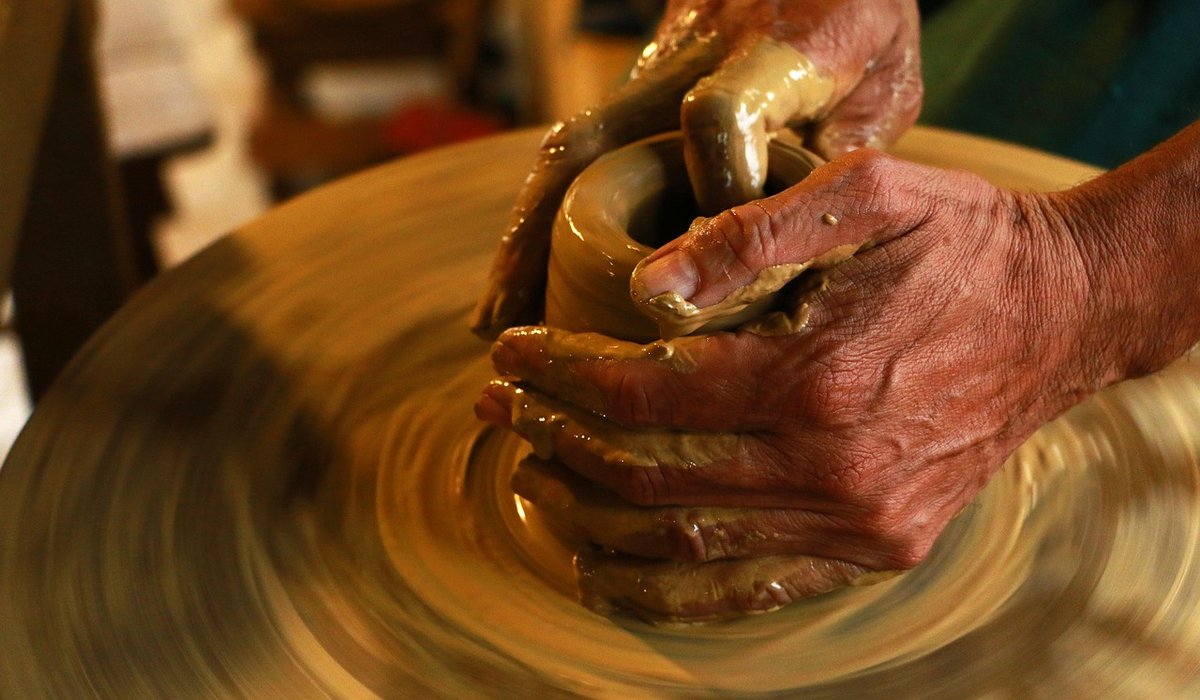
Throwing a vase 30 cm tall is a different craft from throwing a mug. The higher the wall, the more leverage gravity and centrifugal force have over the clay, and the more a single clumsy movement will show up later as a wobble, a thin patch, or a collapse halfway up. Clay has a memory: wherever you squeeze too hard, the wall thins and stays thin. Wherever you leave a lump, it stays a lump until the next pass. Even walls are not made in one heroic pull. They are made in a series of small, lubricated, deliberate ones, each removing a little clay and leaving the surface smoother than the last.
Everything upstream of the pull decides how easy it will be. Centre thoroughly — a cone up and down two or three times opens the clay body and lines up the particles. Open the floor to a consistent thickness, press it flat with a rib, and check it with a needle tool. Throw the initial cylinder wide enough that you have clay to draw from, but not so wide that the walls are already thick and heavy. Aim for roughly a 1:3 ratio of diameter to height before you begin thinning. If the base is off-centre or the floor is uneven, every pull you make afterwards will be fighting that error.
Dry hands drag. Dragging hands tear, and torn clay forces you to stop, patch, and start again — which is exactly how walls become uneven. Keep a bowl of water and a sponge within reach, but use less water than you think. Too much water turns the surface to slippery slip that slides off the wall rather than supporting it, and it softens the very clay you are trying to lift. The sweet spot is a thin, creamy film on the inside and outside of the wall, topped up with a wet sponge every pull or two. If your hands squeak, add water. If the clay goes shiny and soupy, back off and let it firm for a minute.
A tall vase is built from perhaps six to ten pulls, not two. The sequence matters:
Keep the wheel speed steady and reasonably brisk for the first few pulls, then slow it down as the wall thins and the vase grows taller. Tall, thin walls whip and wobble if the wheel is racing. Your hands should feel like they are guiding the clay upward, not dragging it. If you find yourself fighting the clay, the wheel is probably too fast or your hands are too dry.
New throwers often try to thin a wall by pinching it between thumb and forefinger. That creates a groove and a hollow — the classic lumpy spiral. Instead, think of the wall as being stretched between two gently supporting hands. The inside fingers push outward very slightly; the outside fingers resist and travel upward a fraction faster. The clay thins because it is drawn, not crushed. Use a wooden rib on the outside for the last two pulls to true the profile and knock back any ridges, and check thickness with a needle or a pair of calipers at three or four heights before you stop. A wall that feels even under your fingers at the base and the rim is usually even in between.
When a tall throw goes wrong, the cause is usually simple and fixable next time:
None of this is a race. Pull, feel, rest, pull again. The potters who make tall vases look effortless are simply making more, smaller pulls than everyone else, with hands that stay wet and a wheel that stays honest.


We are not gonna make spamming
