
The Clay & Glaze Notebook shares practical, down-to-earth guidance on pottery, ceramics and clay crafts for uk makers for readers across the UK.
- 0123456789
- Angle Bd Abdelmoumen & rue soumaya, Résidence
- [email protected]
The Clay & Glaze Notebook shares practical, down-to-earth guidance on pottery, ceramics and clay crafts for uk makers for readers across the UK.
 By Oliver Pemberton
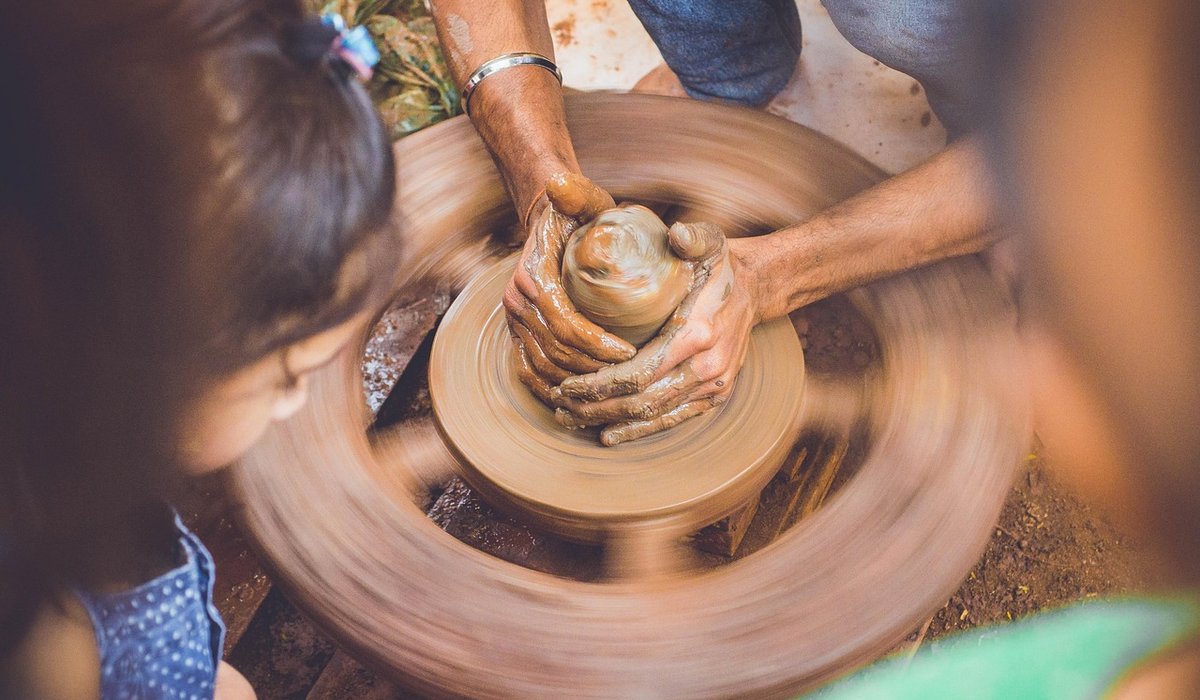
To a newcomer, a bag of clay is a bag of clay. To anyone who has watched three weeks of work craze, crack or slump in the kiln, the name on that bag is anything but incidental. Earthenware, stoneware and porcelain behave differently at every single stage — how they feel under the hand, how much they move as they dry, how hot they must be fired, and how much they shrink along the way. None of them is "better". They simply suit different jobs, different kilns and different makers. Understanding the three families before you hand over your money for 25kg at a bargain price is the cheapest lesson in pottery you will ever get.
Earthenware is the clay of flowerpots, terracotta roof tiles and much of the world's historical pottery. It fires at the lowest end of the scale, roughly 1000–1150°C, and remains porous after firing. It has not vitrified, so it will still absorb water unless it is properly glazed.
Because it stays porous, earthenware is perfect for plant pots, decorative sculpture and anything that does not need to hold liquid. It is a legitimate choice for tableware when fully glazed, but be realistic: a low-fired dish chips more easily and is less tolerant of dishwashers and thermal shock than stoneware. Its iron content also tints glazes, so a clear glaze over red earthenware will never look the same as over a white stoneware.
Stoneware fires between roughly 1200 and 1300°C and vitrifies, meaning the clay particles fuse densely enough that the finished piece is strong, chip-resistant and effectively non-porous. The great majority of domestic tableware and studio pottery made in the UK is stoneware, usually fired somewhere in the 1240–1280°C band.
Stoneware is the sensible default for functional work: mugs, bowls, casseroles, jugs. It takes reduction firing beautifully, responds well to ash and shino glazes, and survives daily use. If you only ever learn one clay body properly, make it this one. Grogged versions are worth keeping in the studio for larger hand-built pieces, as the added grit opens the body, reduces shrinkage and helps prevent cracking.
Porcelain is essentially kaolin (china clay), feldspar and silica, with almost no iron. It fires between about 1250 and 1300°C, and when thin it becomes white and translucent — that soft glow you see through the rim of a well-made cup. Those same virtues make it awkward to work with. Kaolin is not plastic, so porcelain feels "short": it tears, slumps and warps unless you handle it with patience and a light touch.
Porcelain rewards precision and punishes haste. Dry it slowly, support it well in the kiln, and expect a steeper learning curve than with the other two families.
A cylinder thrown 20cm tall in porcelain might emerge from the glaze firing at 17cm. That is not a fault; it is arithmetic. Shrinkage happens twice — first during drying and bisque firing, then again at glaze temperature — and the losses accumulate.
The practical fix is a test tile. Roll or throw a small bar, mark exactly 100mm between two lines, then measure it after the bisque firing and again after the glaze firing. Write the figures in your glaze notebook alongside the clay name. It takes twenty minutes and saves a whole shelf of undersized pots.
Start with your kiln. If it maxes out around 1150°C, earthenware is your family. If you can comfortably reach 1280°C, all three are open to you and the decision becomes about your work rather than your equipment.
Then buy 5kg before you buy 25kg. Throw a few test pieces, fire them, measure the results, and see how the body feels on the wheel and at the bench. Clay is a long relationship, not a single purchase, and the makers who get the best results are simply the ones who took the time to learn what is actually in the bag.


We are not gonna make spamming
